Institutional performance evaluation has long relied on two core frameworks: policy benchmarks and peer rankings. Both remain necessary. Neither directly defines the opportunity set that those outcomes reflect. In today’s environment, this limitation has become more consequential.
Across institutional portfolios, outcomes have become more dispersed. Portfolios with similar objectives and broadly similar policy structures are producing materially different results. These differences are no longer explained solely by asset allocation. Implementation—manager selection, portfolio construction, pacing, and execution—has become a primary driver of results. In this environment, dispersion defines the opportunity set that investors actually faced.
This paper introduces the Dispersion Capture Ratio (DCR), a framework for measuring implementation at the total portfolio level. DCR evaluates performance as a share of the observable opportunity set, rather than as a simple rank, measuring how much of that opportunity was captured. It is designed to complement, not replace, policy benchmarks and peer comparisons.
Neither policy benchmarks nor peer rankings produce this calculation. DCR quantifies, in basis points and dollars, how much of the available opportunity was captured—and how much was not.
DCR becomes most useful when paired with a Dispersion Level measure, which defines the size of the opportunity set in which results occur. In periods of high dispersion, differences in implementation can have meaningful economic consequences. In periods of lower dispersion, the economic impact of those differences is more limited. Together, DCR and Dispersion Level provide a more complete framework for interpreting institutional performance.
DCR measures how much of the opportunity set was captured—providing a consistent measure of outcomes across institutional portfolios.
A Structural Shift in Portfolio Outcomes
In this paper, dispersion refers to the spread between the 5th percentile (top-performing) and 95th percentile (lowest-performing) returns across institutions.
Over the past decade, dispersion across institutional portfolios has increased materially, with the shift becoming more pronounced since 2020. Institutions with similar objectives and broadly similar policy structures are producing increasingly different outcomes.
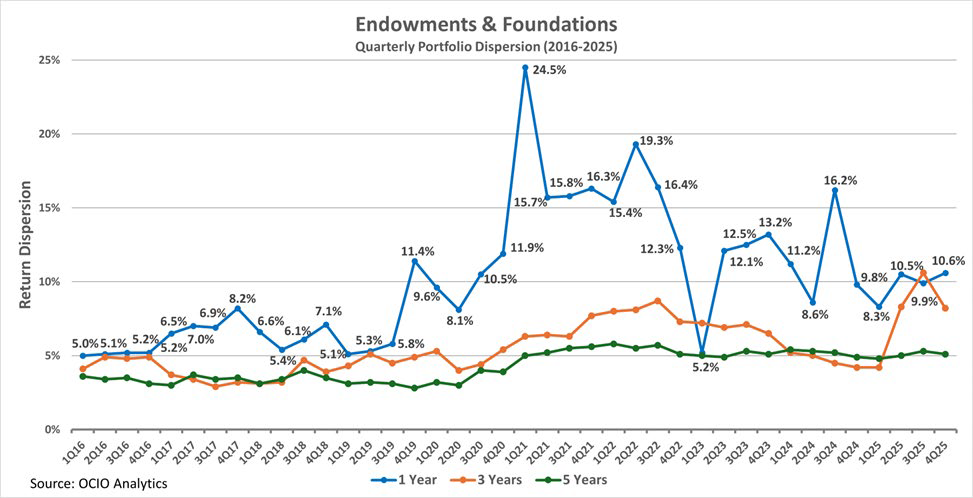
This is not about changing risk tolerance but rather about implementation. As institutions have allocated more to private equity, venture capital, private credit, hedge funds, and other alternatives, the range of outcomes has widened. Manager selection, vintage year exposure, valuation timing, pacing, and portfolio construction have always influenced results. In a structurally higher dispersion environment, they now determine outcomes.
Implementation has always mattered. It now drives outcomes.
Beyond Policy Benchmarks and Peer Rankings
Institutional performance has historically been assessed through two lenses:
- Policy Benchmark: Did the portfolio perform in line with its allocation?
- Peer Ranking: Where did it rank versus comparable institutions? Both are useful, but neither is complete.
DCR adds a third measure:
- DCR + Dispersion Level: How much of the available opportunity was captured, how much remained uncaptured, and did the result meaningfully matter?
This question belongs to every institutional investor. Regardless of how a portfolio is managed—OCIO, consultant, or internal team—the opportunity set is the same, and so is the value of capturing it. DCR makes that value visible.
What DCR Measures
The Dispersion Capture Ratio measures how much of the available performance spread within a peer universe a portfolio captures.
DCR is calculated as follows:
- DCR = (Portfolio Return – 95th Percentile Return) ÷ (5th Percentile Return – 95th Percentile Return)
Where:
- 5th percentile = top-performing portfolios
- 95th percentile = lowest-performing portfolios
The result is bounded between 0 and 1, where 1 represents full capture, and 0 represents none.
The 5th percentile is not a target or expected outcome—it represents the realized upper bound of the peer universe. By anchoring to both the upper and lower bounds, DCR defines opportunity across the full range of outcomes, establishing a measurable opportunity set.
The question is not whether a portfolio matched the best result, but how much of the available opportunity was captured—and how much was uncaptured. This framework is not a judgment of outcomes, but a measurement of how results relate to the opportunity that existed.
Using total portfolio returns, DCR anchors performance to the full observed distribution of outcomes, enabling evaluation of implementation without requiring asset-level attribution.
Dispersion Level Definition
The Dispersion Level is defined using the spread between the 5th and 95th percentile returns relative to its 10-year historical distribution:
- High Dispersion: More than one standard deviation above the 10-year mean
- Normal Dispersion: Within one standard deviation of the 10-year mean
- Low Dispersion: More than one standard deviation below the 10-year mean
The use of standard deviation provides a consistent, data-driven way to assess whether the current range of outcomes differs meaningfully from historical norms.
In low-dispersion periods, portfolios are tightly clustered. Differences in implementation often appear meaningful statistically, but have a more limited effect on long-term wealth. In high-dispersion periods, the opposite is true—small differences in implementation can lead to large and lasting differences in outcomes. DCR always measures how much of the opportunity was captured. The Dispersion Level determines how much the capture matters.
Interpretation Framework: From Measurement to Decision
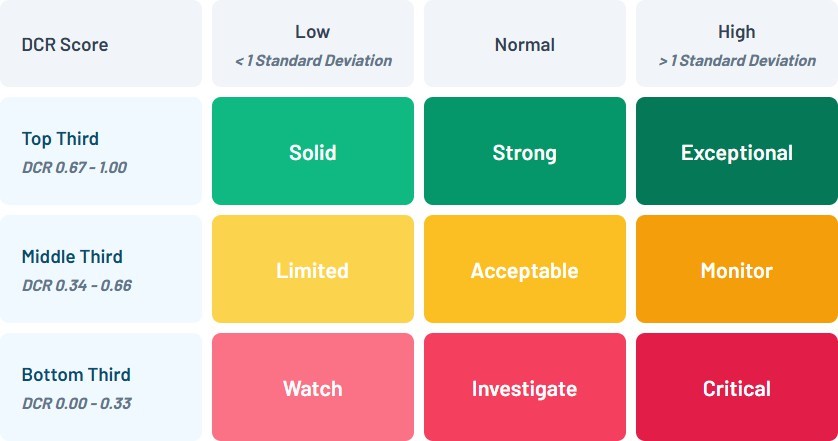
The value of DCR lies not only in measurement, but in interpretation. DCR shows how much of the available opportunity was captured. Dispersion Level defines the size of that opportunity set—and therefore how much the result mattered.
Together, they form a two-dimensional framework for evaluating outcomes.
Dispersion Level (left to right) defines the size of the opportunity set, while DCR (top to bottom) reflects the degree of capture.
From Measurement to Economic Value
DCR converts performance into measurable economic value.
Assume: Dispersion = 900 basis points
DCR: 0.60
Captured Opportunity: 0.60 × 900 = 540 basis points
Uncaptured Opportunity: 900 – 540 = 360 basis points
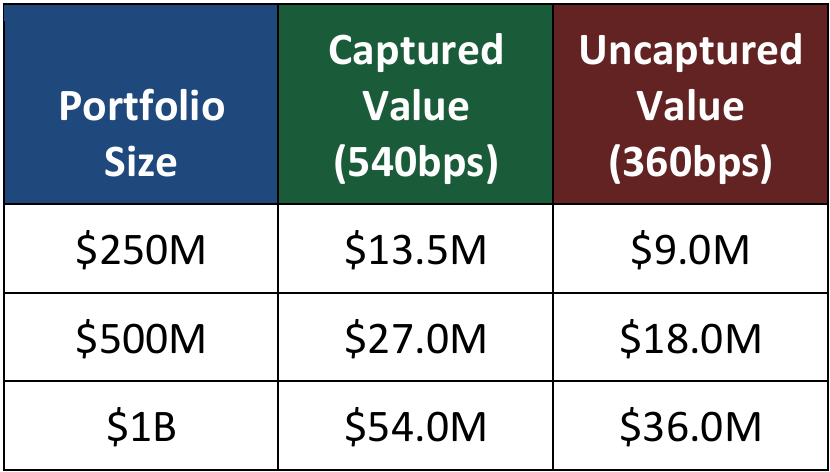
This is a single-period illustration. Over time, compounding materially widens the gap between captured and uncaptured value.
Conclusion
Institutional investing has entered a period of structurally higher dispersion, where portfolios with similar objectives can produce materially different outcomes. In this environment, implementation—how portfolios are constructed, managers are selected, and strategies are executed—has become a primary driver of results. The Dispersion Capture Ratio measures the proportion of the available opportunity that was captured, with the opportunity defined across the full range of observed outcomes. The Dispersion Level determines whether that outcome meaningfully impacted wealth.
This shift reframes a central question in institutional investing. The focus is no longer only on where a portfolio ranked or how it performed relative to a benchmark, but on how effectively it converted opportunity into results. This framework applies to any institutional portfolio—regardless of whether it is managed by an OCIO, a consultant, or an internal team—and does not evaluate who manages the portfolio, but rather what the portfolio achieved relative to what was possible.
Dispersion defines the opportunity. DCR measures how much of it was captured—and quantifies its value.

 Follow Us